“Papa Don’t Leech”
A horticultural expedition log through 4 Southeast Asian countries
by Alan Galloway, Bjørn Malkmus-Hussein, David Prehsler and Derek Carwood
Countries Explored: Philippines, Vietnam, Thailand and Laos
10 August 2018 to 14 September 2018
Click here for a PDF version of this document suitable for printing or view on a cellphone
All of the trip participants have interests in diverse plant families, but all 4 of us have a concentrated interest in Araceae and Zingiberaceae, and Southeast Asia is undoubtedly a prime geographical hotspot for these genera. This trip was the second time all 4 of us have visited Southeast Asia together. Like so many areas around the planet, this region is losing vast amounts of pristine and species-rich primary forest to infrastructure development and harvesting of natural resources, especially timber and limestone.
Note: Click on the thumbnail photos to view the full-size image
Friday, August 10, 2018
Alan’s flight departed Raleigh, NC at 7:50am and had a 2.5 hour layover in San Francisco.
Saturday, August 11, 2018
Luckily it was a rather quiet flight from San Francisco to Taipei, Taiwan, so he was able to get some sleep, which was much needed considering he did not get any Thursday night packing for a 5 week trip. He had a 3.5 hour layover in Taipei and arrived at Manila airport, Philippines at 11pm, but had to sit on the tarmac for another hour before debarking the plane since heavy rain had caused some delays. Alan went through immigration, picked up luggage, cleared customs without incident, and exchanged some US dollars into Philippine pesos. The Manila airport consists of 4 terminals, all being at quite some distance from each other, so he took a taxi from terminal 1 to a budget hotel, directly across the road from terminal 4 from which he would fly onto Palawan a couple of hours later that day.
Sunday, August 12, 2018
Alan had just enough time to take a shower and to repack his luggage. Since there is a strict weight limit on how much luggage one can carry on the inland flight from Manila to El Nido, he packed just enough clothes into a small carry-on luggage and his backpack, and left his larger piece of luggage at the hotel to be picked up on his return. Dr. Lanie Medecilo, a botanist at De La Salle University - Dasmariñas, Philippines had asked for some
Amorphophallus DNA samples, so he left them at the hotel for her to pick up. The airplane left Manila at 5:55am and arrived in El Nido at 7:10am. Alan took a tuk-tuk from the airport to Raab’s Botanica coffee shop. The rest of the day was spent walking around El Nido and touring Raab’s plant collection. For the night the
Amakan hotel was chosen right across the street from
Raab’s Botanica coffee shop.
Tuesday, August 14, 2018
Will and Alan departed from El Nido at 6am, taking a couple of shuttle van rides south and then taking a 1 hour boat ride to Damaron Island. Once on the island we took a 1 hour motorbike ride to Araceli, where we had dinner with Will’s friends, Dickie Coronia Rodrigues and Bradley Dowenz. The night was spent in a hotel in Araceli.
Alan’s pics for today:
August 14, 2018
Copyright 2018 to present
Alan Galloway
|

Overlooking the Sulu Sea
|
Wednesday, August 15, 2018
Will and Alan, along with Dickie and Bradley, took a 1 hour boat ride to an uninhabited island to see a new species of Amorphophallus species Will discovered a few years earlier. Just as we started the trek up the mountain Alan took a very nasty fall and injured his left elbow. Within minutes he was not able to move his elbow anymore and was worried he had broken it. Facing the exciting possibility of finding a new species, Alan forgot about the pain, and he was able to make it up the mountain with only one good arm! The new species was growing on slopes in shaded areas and several plants had nearly-mature fruit. Once back down from the mountain the guys spent a few hours snorkeling and fishing, while Alan stayed on the boat with an injured arm. Back in Araceli, we bought some fish at a local market, which Will and Dickie grilled to perfection!
Alan’s pics for today:
August 15, 2018
Copyright 2018 to present
Alan Galloway
|
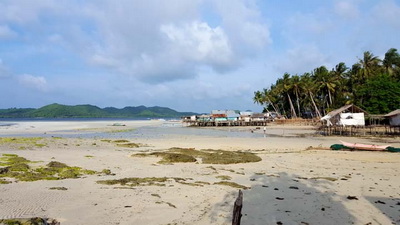
Damaran Island
|

Boat riding in the Sulu Sea
|
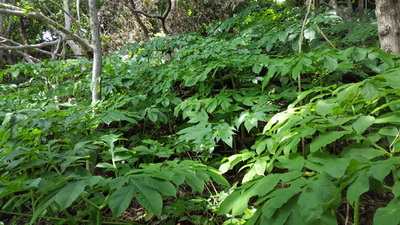
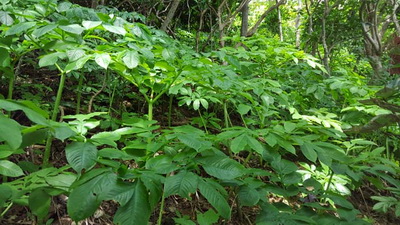
Amorphophallus species
|
Thursday, August 16, 2018
Will and Alan took a 6 hour boat ride from Araceli back to mainland Palawan. Will headed back to Puerto Princess and Alan took a 3 hour shuttle van north back to El Nido.
Alan’s pics for today:
August 16, 2018
Copyright 2018 to present
Alan Galloway
|
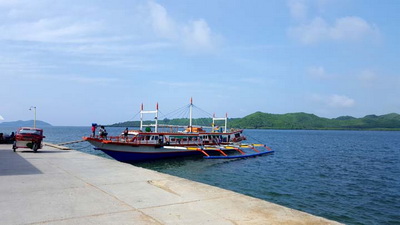

Boatride back to Palawan
|
Saturday, August 18, 2018
Alan spent the morning walking around the edge of El Nido City. In a forested area in the vicinity of the town, he found more plants of the ‘roughish petioled’
Amorphophallus species, with several plants having mature fruit. After lunch Raab and Alan took a trip around the northern tip of Palawan. At one of the stops at a karst mountain they found an
Amorphophallus species growing with a few ripe seedheads. On the way back to El Nido, they stumbled across another
Amorphophallus species growing at the edge of a corn field with several large ripe seedheads.
Alan’s pics for today:
August 18, 2018
Copyright 2018 to present
Alan Galloway
|

Amorphophallus cf. declinatus
|

Clinging vine
|

El Nido Bay
|

Overlooking El Nido Bay |
Sunday, August 19, 2018
Alan left the hotel via a tuk-tuk at 5am for the El Nido airport. He arrived at terminal 4 in Manila, picked up his luggage across the street at the hotel and then took a taxi to terminal 2. It took 3 hours to check in and go through immigration. A Chinese aircraft ran off the runway Friday and delays lasted 3 days. Because of the long delay leaving Manila he was extremely late catching his connecting flight in Ho Chi Minh City, Vietnam. As soon as he stepped into the terminal in Ho Chi Minh City there were 3 Vietnam Airlines staff members waiting for him. They called ahead and asked the national flight going to Hanoi to wait for him. Since he had to change terminals in the rain, two of the staff members held umbrellas and the third staff member helped him with the luggage. They even escorted him to the front of the security line so he could catch the flight to Hanoi. If only all airlines ranked customer service as much as Vietnam Airlines! Alan arrived at Hanoi airport about 9pm, exchanged some US dollars for Vietnam dong and checked into a hotel very near the airport.
Alan’s pics for today:
August 19, 2018
Copyright 2018 to present
Alan Galloway
|

Airplane between Manila and El Nido
|
Monday, August 20, 2018
Son Hoang, Vietnamese Academy of Forest Sciences, and the driver picked Alan up at 8am and we drove north to Na Hang. Since it took most of the day to get to the hotel, there was no time to make any stops along the way.
Tuesday, August 21, 2018
After breakfast Son Hoang and Alan hiked up a mountain in Na Hang Nature Reserve.
Arisaema lihengianum was one of Alan’s ‘target’ plants to locate and photograph on this trip. Since Son Hoang had written a paper in 2015 on finding this species in Vietnam, they had no problems locating it. About halfway up the mountain they found it in a couple of spots growing in pockets of dark humus soil amongst rock boulders. Unfortunately flowering season was May and the plants could only been admired in leaf. Son Hoang pointed out an epiphytic
Hedychium species he discovered earlier that is in the process of being described. This area was rich in so many plant families. Seen along the path to the summit were
Asarum balansae, an
Aspidistra species with spotted leaves, the beautiful burgundy spotted petiole of
Disporopsis longifolia, at least 2 species of
Camellia,
Amorphophallus tonkinensis and
A. coaetaneus and some huge trees of
Magnolia conifera.
Near the summit is a reserve forestry station and since we arrived there at mid-day the staff invited us to stay for lunch. Afterwards the forestry staff guided us the rest of the way to the summit. By the time Son Hoang and Alan got back down the mountain and the driver picked us up, it was almost dark, so we quickly went back to the hotel and got cleaned up for dinner.
Alan’s pics for today:
August 21, 2018
Copyright 2018 to present
Alan Galloway |


Amorphophallus coaetaneus seedhead
|
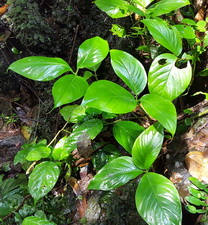
Arisaema lihengianum |

Hedychium species nova
|

Asarum balansae |

Camellia luongii
|

Impatiens parvisepala |

Snake resting on
Amorphophallus tonkinensis |
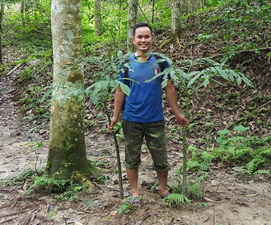
Son Hoang with
Amorphophallus tonkinensis
|

Refueling after a long day |
Wednesday, August 22, 2018
Son Hoang and Alan left Na Hang and met up with an orchid friend of Son Hoang and all 3 of us hiked around Chiem Hoa. We saw another
Asarum species growing in tight cracks of rock boulders and several
Impatiens species. After lunch Son Hoang and Alan started the drive back south and stayed the night in Tam Dao.
Alan’s pics for today:
August 22, 2018
Copyright 2018 to present
Alan Galloway
|
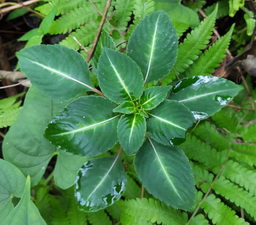
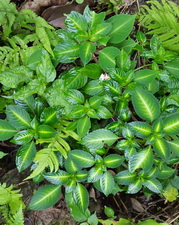
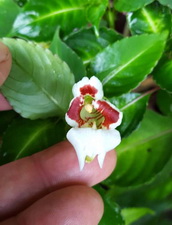
Impatiens morsei
|
Thursday, August 23, 2018
After breakfast and a stop at a coffee shop we hiked around Tam Dao. During the hike we saw several plants of
Arisaema petelotii with green seedheads. This is a rhizomatous species with huge trifoliate leaves. One lost count of how many species of
Begonias could be seen at this site. It was quite exciting to see
Aucuba obcordata, as well as another species growing along the hiking paths. Another unidentied
Camellia species was seen as well as another unidentified
Magnolia species. After lunch we headed back to Hanoi. Son Hoang and the driver dropped Alan off at the same hotel, but before he left Son Hoang gifted him with a bag of Vietnamese coffee… apparently he noticed that Alan was addicted to it!
Friday, August 24, 2018
In the morning Alan flew from Hanoi to Bangkok, Thailand, where he arrived at the older airport. There he exchanged some US dollars into Thai baht and walked across the street to the Amari hotel and met up with Bjørn Malkmus-Hussein and David Prehsler, who arrived in Bangkok the day before. The driver picked us up and we began driving northwest to Sai Yok in Kanchanaburi province. One stop was made before reaching Sai Yok at Krasak Cave. There was found what appeared to be
Typhonium trilobatum.
Sunday, August 26, 2018
We left Sai Yok and drove northwest toward Thong Pha Phum. Stop #1 - Shortly after leaving Sai Yok, we stopped along the main road just to see what kind of plants we might find. Surprisingly we located Amorphophallus linearis growing on the ditchbanks in rather dry gravel soil.
Stop #2 – Just a few feet off the edge of the road we saw a giant form of Amorphophallus paeoniifolius, as well as A. muelleri. Also several species of Alpinia, Boesenbergia, Curcuma and Zingiber were growing here.
Stop #3 – Sai Yok Yai Waterfall – The only two interesting plants found at this site were a Globba species and Tacca cf. plantaginea, the latter one growing directly next to and even in the water.
Stop #4 – Temple site – We spotted an Amorphophallus species here which belongs to the group formerly classified as a Pseudodracontium. Also seen were colonies of a nicely patterened form of a Hapaline species.
Stop #5 - (Northwest of Thong Pha Phum) – Amorphophallus cicatricifer and A. amygdaloides were growing there, along with dense stands of Englerarum hypnosum, all three of them in karst rock cracks. And to everyone’s excitement we also found Sauromatum cf. tentaculatum. Since it was raining, taking photos was nearly impossible, so we all agreed to come back to this site the next morning. We made our way back to Thong Pha Phum and stayed in a hotel along the river.
Alan’s pics for today:
August 26, 2018
Copyright 2018 to present
Alan Galloway |

Amorphophallus linearis |

Clerodendrum ???
|
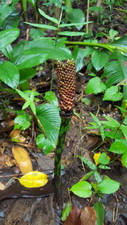
Amorphophallus muelleri seedhead |

Boesenbergia parvula |
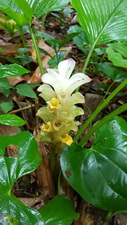
Curcuma aurantiaca |

Hapaline species |


Amorphophallus paeoniifolius |
Bjørn’s pics for today:
August 26, 2018
Copyright 2018 to present
Bjørn Malkmus-Hussein |

Amorphophallus amygdaloides
|

Amorphophallus linearis |

Englerarum hypnosum leaves |

Englerarum hypnosum inflorescence |

Amorphophallus muelleri |

Sauromatum tentaculatum
|
Monday, August 27, 2018
Stop #1 – We returned to yesterday’s last stop to take some photos. In addition to the species already seen yesterday, we also found an Arisaema species with trifoliate leaves, a near-red flowering Globba species growing in small rock crevices in vertical rock walls, a beautiful silver veined Impatiens species, and several Sauromatum horsfieldii plants and a single specimen of S. hirsutum.
Stop #2 - Between Thong Pha Phum and Khao Laem National Park, we located more Amorphophallus maxwellii and A. amygdaloides, along witha few more plants of Sauromatum cf. tentaculatum. Probably this species is more widespread in Kanchanburi province if habitat is suitable: shaded spots in almost vertical rock walls which seem to retain more moisture during the dry season. It was early afternoon and we were approaching Sangkhla Buri, much too early to start the daily hotel search, so we opted to drive north about 45 minutes to Three Pagodas Pass at the Thai/Myanmar border. There is a small market and sometimes some nice plants are being sold by the Myanmar locals. Bjørn found some Curcuma cultivars that he couldn’t live without. We ended the day at a hotel back in Sangkhla Buri.
Alan’s pics for today:
August 27, 2018
Copyright 2018 to present
Alan Galloway
|

Impatiens species
|

Impatiens species |

Sauromatum tentaculatum |
Tuesday, August 28, 2018
As we now had reached our most distant point from Bangkok, we started our trip back.
Stop #1 - Between Sangkhla Buri and Khao Laem National Park – Even though this area was quite hilly and covered with forest, it was extremely wet. We really didn’t expect to find any Amorphophallus species in this kind of habitat, but much to our surprise we located 2 species that were not identifiable neither from their leaves nor the location, so perhaps they are new species. One of the species found by Bjørn had nearly black petioles and also formed intercalary bulbils. In the other species the fruits were maturing to near-white in color. On a very steep and open clay wall we encountered a nice colony of Monolophus, a tiny ginger with relatively large flowers – the only record of that genus for the whole trip.
Stop #2 – At this site we found an Amorphophallus species from the formerly recognised genus Pseudodracontium that was nearly a meter tall with lanceolate leaflets.
Stop #3 – Kroeng Krawia Waterfall – Southeast of Khao Laem National Park – Again we found more Amorphophallus maxwellii and A. amygdaloides at this site. Given that we had now seen hundreds of plants of these 2 species, we began to take note of the variation in the petiole pattern and coloration. We noticed that the petioles of A. maxwellii could be nearly solid black, green, or even white… the color variation was just amazing! Rocks around the waterfall were overgrown with a lovely display of Begonia prolifera and Argostemma lobbii, both growing in a very thin layer of moss.
Stop #4 – Between stop #3 and Thong Pha Phum - David found the Amorphophallus species that was on Alan’s ‘target’ list – one he had found already some 15 years earlier that most likely is an undescribed species. This Thai species seems to have a disjunct look-alike in northern Vietnam. Bjørn also saw Curcuma rubrobracteata here with showy bright red bracts. We stayed at the same hotel at the river from 2 days earlier in Thong Pha Phum.
Alan’s pics for today:
August 28, 2018
Copyright 2018 to present
Alan Galloway
|


Kroeng Kra Wia Waterfall
|

Clerodendrum paniculatum
|
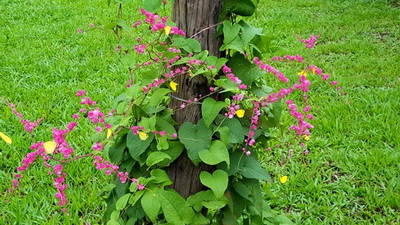
Antigonen leptopus |

Curcuma aurantiaca (front)
Curcuma roscoeana (rear) |
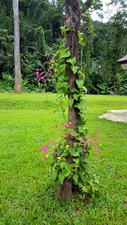
Antigonen leptopus |
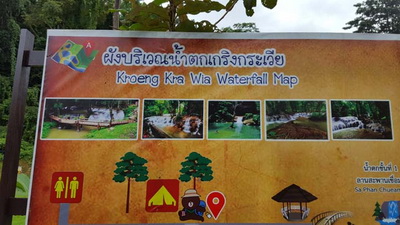
Kroeng Kra Wia Waterfall
|


Curcuma rubrobracteata
|

Variegated vine |
Bjørn’s pics for today:
August 28, 2018
Copyright 2018 to present
Bjørn Malkmus-Hussein |

Amorphophallus maxwellii
|

Amorphophallus spc. nov. intercalary bulbils |
Wednesday, August 29, 2018
Stop #1 – Since it was approaching sunset yesterday when we were at this site, we returned back to the last stop from yesterday to take some photos.
Stop #2 – between Thong Pha Phum and Sai Yok – We had almost given up on finding some of the other ‘target’ plants to take some photos, but at least this stop provided us the opportunity to capture photos of Amorphophallus cirrifer and A. longituberosus, both growing in rather dry gravel soil.
Stop #3 (after lunch) – David located a Typhonium species wedged in the crack of a vertical rock wall about 3 meters above the ground. Since he wanted to get a photograph of it, he had to climb on Alan’s shoulders to get it to eye level. We ended the day staying in the same hotel in Sai Yok as we stayed in a few days earlier.
Alan’s pics for today:
August 29, 2018
Copyright 2018 to present
Alan Galloway |

Globba species
|
Thursday, August 30, 2018
We left Sai Yok and returned to August 26
Amorphophallus linearis stop
Stop #1 – We were so excited to find
Amorphophallus linearis a few days earlier, we all forgot to take any photos, so we made a quick return to that site.
Stop #2 – From Sai Yok, we drove southeast to the 1st temple stop on a side road to Erawan Waterfall – We did not find any exciting plants at this stop, but we all got a good leg workout from climbing the Temple’s steps!
Stop #3 – On the main road to Erawan Waterfall – Here were growing a beautiful form of
Typhonium laoticum with silver leaves, and a stunning lavender flowered
Impatiens species. We were all blown away by the variation of leaf patterns of
Kaempferia roscoeana that were wedged into the karst rocks. We also found what we think was a very fine-leafed form of A
morphophallus longituberosus.
Stop #4 – Erawan Waterfall – This is one of Thailand’s National Parks with stunning waterfalls. We were not quite sure what to make of the diamond shaped sign with a cobra painted on it along the walking path! We would have loved to see one king cobra (from a distance), but they seem to be extremely shy.
Stop #5 – On the same side road as stop #2 – 2nd temple stop – As we climbed up the steep hill behind the temple, we saw a beautiful form of
Amorphophallus cf. macrophyllus, and what we think may be a new species of
Amorphophallus with deep green leaflets and margined in magenta; this species has started showing up in collections in recent years. Tubers were growing deeply buried in very narrow rock cracks. After this stop we continued on to Kanchanaburi City to find a hotel for the night.
Alan’s pics for today:
August 30, 2018
Copyright 2018 to present
Alan Galloway
|
 
Kanchanaburi Province
|

Typhonium cf. laoticum |

Amorphophallus cirrifer
|
 
Kaempferia roscoeana
|

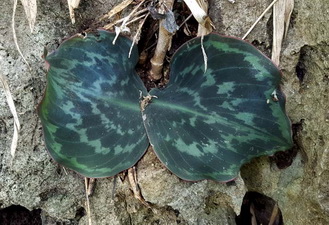


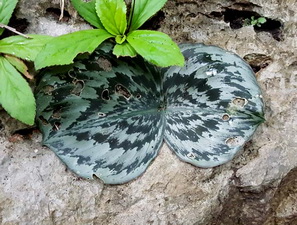
Kaempferia roscoeana |

Typhonium cf. laoticum |

Kaempferia udonensis |
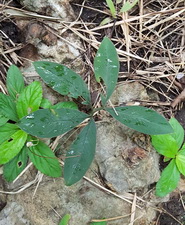
Amorphophallus species |

 
Impatiens cf. namchabarwensis
|

Cobra crossing road sign
|
Bjørn’s pics for today:
August 30, 2018
Copyright 2018 to present
Bjørn Malkmus-Hussein |

Kaempferia roscoeana
|

King Cobra sign at Erawan Waterfall |
Friday, August 31, 2018
After breakfast we departed Kanchanburi City for the long drive back to Bangkok. Derek had already made hotel reservations for all of us very near the new airport, so check-in was quite fast. After dinner David went to the airport to pick up Derek.
Saturday, September 1, 2018
We arrived at the Bangkok airport with enough time to have breakfast together and to map out where we would be traveling in Laos. Once we arrived in Vientiane, we got our visas on arrival, exchanged some US dollars into Lao kip and met the driver in front of the terminal. Since it was approaching lunch time, we asked the driver to find us a place to eat, so he carried us to one of his favorite places to eat. We made a quick stop to pick up some bottled water and snacks and spent the rest of the day driving south on highway 13, the main north/south road in Laos. Once we reached the town of Paksan, we took the road north to Borikhan and found a hotel for the evening.
Sunday, September 2, 2018
We left Borikhan and headed north, then east, and then south towards highway 8.
Stop #1 – Since we had been driving for a few hours, this was more of a ‘stretch your legs’ stop than a stop to look for plants.
Stop #2 – After seeing miles and miles of flat rice fields, we spotted a single karst mountain rising from the rice paddies and found it to be quite abundant with interesting plants. Here we located Amorphophallus bolikhamxayensis (several specimens were fruiting), a fairly large leafed and probably new Typhonium species, a pale pink flowering Impatiens species, a nice yellow flowering Globba species and large stands of Calanthe orchids, probably C. vestita, which must make quite an impressive aspect when in flower.
Stop #3 – A fairly steep hill with a water stream. Probably all of us ended up slipping down multiple times from all the wet dirt. Some very tall forms of Disporopsis longifolia were in full fruit. We also found 2 potentially new Amorphophallus species at this site.
Stop #4 – After lunch, a second water stream – Bjørn found an Aglaonema species with huge ripe fruits.
Stop #5 – Karst mountain – We spotted more Amorphophallus bolihamxayensis, a nicely spotted leaf Aspidistra species and a trifoliate-leafed Arisaema species from section Anomala. Since it was beginning to get dark, we decided to make our way southward to highway 8 and then westward to Lak Xao to find a hotel.
Alan’s pics for today:
September 2, 2018
Copyright 2018 to present
Alan Galloway |

Impatiens species
|
Bjørn’s pics for today:
September 2, 2018
Copyright 2018 to present
Bjørn Malkmus-Hussein |

Amorphophallus bolikhamxayensis
infrutescence
|

Typhonium spec. nov. |

Amorphophallus spec. nov. 1 |

Amorphophallus spec. nov 2 |
Monday, September 3, 2018
From Lak Xao, we drove east toward the Vietnamese border.
Stop # 1 – very close to the border – Since it had rained a few hours before sunrise, everything was soaking wet, but after a couple of minutes trekking from the roadside, this area proved quite rich in Amorphophallus. We saw what we think may be 4 new species, as well as finding a very large species that might have been Amorphophallus kachinensis. Bjørn, David and Derek were waiting by the van till Alan came down the hill. Alan was curious as to why everyone was pointing at him. Once Alan looked down at his legs he realized the reason. He had about 30 leeches on each leg and quite a bit of blood! Leeches are covered with some kind of slime, once you touch them, the slime prevents you from grasping anything with your fingers, so he had to carve them off his legs with a pocketknife. Since he was the elder member of the team, David began the chant, ‘Papa don’t leech’.
We returned to Lax Xao and then went south.
Stop #2 – The trees had been logged from most of this area for timber and the remaining areas were converted into rice paddies, so there were not many areas to find interesting plants.
We returned back to Lak Xao for lunch. While sitting in the restaurant waiting for our food, a larger leech had filled itself on Alan’s blood, fallen off and started crawling across the restaurant floor just as the waitress was bringing out our food. The poor woman went screaming back to the kitchen area.
Stop #3 – After lunch we went west to the site where Petra Schmidt, Annop Ongsakul and Alan discovered Amorphophallus arcuspadix back in 2003. At that time there were thousands of plants growing in the area, but since the trees had grown so much in the past 15 years, they had shaded out the area and we only saw a few remaining plants growing in rock crevices.
We returned to Lak Xao and went north. As we did not find any good places to search for plants, we decided to head back to the hotel in Lak Xao.
Alan’s pics for today:
September 3, 2018
Copyright 2018 to present
Alan Galloway |

Attacked by leeches |

Amorphophallus arcuspadix |
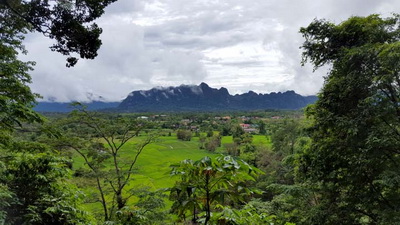
Overlooking Lak Xao
|

The gang at dinner
|
Tuesday, September 4, 2018
We left Lak Xao and drove westward to Ban Phônkho.
Stop #1 – just west of Lak Xao – Growing in heavy shade, we found a beautiful silver centered form of a
Peliosanthes species - and more leeches.
Stop #2 – Dragon Cave – Central Laos features numerous caves in karst mountains and when these are found along the roadside, they make for great tourist stops. Here we found a beautiful pale pink
Impatiens species, a bright red-bracted
Zingiber species and 2 species of
Habenaria orchids.
Stop #3 – Our next stop was at the site where Amorphophallus pulchellus was originally discovered. Sadly this site has practically been destroyed due to development. We were only able to find a single, rather young plant to photograph – probably the last of its species. Fortunately, this species is quite prolific in cultivation and thus in the long term it may survive at least ex situ.
Stop #4 - Here we found Amorphophallus bolikhamxayensis, which seems quite wide-spread in this area, almost always confined to karst formations.
Stop #5 (after lunch) – Water stream near Ban Phônkho – growing in wet areas we found a single patch of an Amorphophallus species with glossy leaflets and which may turn out to be a new species.
Stop #5 – Our last stop of the day was the original site where Amorphophallus barbatus was discovered. It was nice to find a handful of additional plants scattered in a larger area than originally seen, although they were extremely sparse and it took a lot of rock climbing to explore this area. At the same site we were also looking to rediscover an undescribed Amorphophallus species which we had seen there on an earlier excursion back in 2015. It belongs to a group of tiny species which have all been described in recent years and are known from central Laos only: A. claudelii, A. myosuroides, A. ongsakulii and A. pulchellus.
We made our way back to Ban Phônkho, finding a hotel right at sunset. We drove to a restaurant that was popular among truckers. By the time our food arrived and we had eaten, our van had gotten boxed in by several big trucks. It took quite some time for the restaurant owner to get the truck owners to move their trucks so we could leave.
Alan’s pics for today:
September 4, 2018
Copyright 2018 to present
Alan Galloway |

Colocasia heterochroma
|

Zingiber species |

Impatiens morsei |

Statue
|

Habenaria rhodocheila |

Habenaria medusa
|

Habenaria medusa |

Amorphophallus pulchellus |

Amorphophallus bolikhamxayensis |

Amorphophallus barbatus |

Amorphophallus malkmus-husseinii |

Amorphophallus laoticus seedhead |
Derek's pics for today:
September 04, 2018
Copyright 2018 to present
Derek Carwood
|

Amorphophallus barbatus
|
Bjørn’s pics for today:
September 4, 2018
Copyright 2018 to present
Bjørn Malkmus-Hussein |

Amorphophallus barbatus
|

Amorphophallus pulchellus |

Amorphophallus malkmus-husseinii at
Amorphophallus barbatus site |

Zingiber spec. at Dragon Cave |
Thursday, September 6, 2018
After breakfast we left Thakhek and headed east on highway 12 toward Gnommalat. We made several stops today finding
Amorphophallus coudercii,
A. gallowayi,
A. laoticus,
A. myosuroides and just a handful of
A. ongsakulii at the original site of this species, several
Begonia species, the stunning silver centered
Impatiens morsei and once again - more leeches.
We stayed in Fang Deng (very near Gnommalat).
Alan’s pics for today:
September 6, 2018
Copyright 2018 to present
Alan Galloway
|


Impatiens morsei
|

Amorphophallus gallowayi
|

Begonia hinnamnoensis |

Amorphophallus laoticus |

Amorphophallus myosuroides |
Derek’s pics for today:
September 6, 2018
Copyright 2018 to present
Derek Carwood
|


Blue-leafed Begonia sp. with flower |
Bjørn’s pics for today:
September 6, 2018
Copyright 2018 to present
Bjørn Malkmus-Hussein |

Amorphophallus ferruginosus |

Amorphophallus gallowayi 1
|

Amorphophallus gallowayi 2 |

Amorphophallus ongsakulii |
Friday, September 7, 2018
We left Fang Deng and drove east toward the Vietnamese border. We made several stops during the day finding
Amorphophallus kachinensis and
A. khammouanensis. Along a stream with large boulders we found the stunning miniature
Begonia hymenophylla with relatively large pink flowers growing in the moss on the boulders. At one of the stops we spotted lots of
A. ferruginosus plants growing, with some of them having ripe seed heads. Also, the very large leafed
Colocasia gigantea is fairly common in this area.
We returned back to Fang Deng and stayed at the same hotel as last night. Since there was only one restaurant in Fang Deng we had several meals there and the restaurant owners had learned we were serious coffee drinkers (or rather coffee addicts) so by the second day they were bringing us coffee even before we were out of the van.
Alan’s pics for today:
September 7, 2018
Copyright 2018 to present
Alan Galloway
|
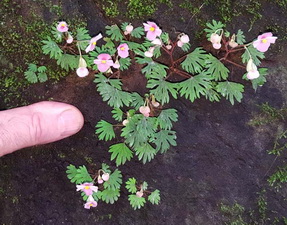


Begonia hymenophylla |

Karst Mountain – central Laos |

Amorphophallus paeoniifolius seedhead |

Amorphophallus ferruginosus |

Amorphophallus ferruginosus seedhead |
Bjørn’s pics for today:
September 7, 2018
Copyright 2018 to present
Bjørn Malkmus-Hussein
|

Amorphophallus ferruginosus
|

Amorphophallus kachinensis |

Amorphophallus khammouanensis
|

Colocasia gigantea
|
Saturday, September 8, 2018
We left Fang Deng and drove west toward Thakhek, making several stops along the way. We found a couple of
Zingiber species, several
Begonia species and at least 2
Crinum species. Also seen were
Amorphophallus ferruginosus,
A. gallowayi,
A. laoticus,
A. crispifolius,
A. myosuroides,
A. longituberosus,
A. coudercii and
Typhonium laoticum. At the second to last stop we found a large hawkmoth caterpillar feeding on the leaflets of
A. laoticus. Our very last stop of the day before returning to our hotel in Thakhek was a cave site. Surprisingly we found a second population of
A. ongsakulii. The original population has been overgrown by more competitive plants and only a handful of younger specimens are left at that site. Thus the location of a second and apparently more stable population was quite interesting.
Alan’s pics for today:
September 8, 2018
Copyright 2018 to present
Alan Galloway
|

Typhonium cf. laoticum |

Caterpillar eating
Amorphophallus leaves
|

Impatiens species
|

Impatiens species
|
Derek's pics for today:
September 8, 2018
Copyright 2018 to present
Derek Carwood |

Begonia sp. “fox begonia”
|
Bjørn’s pics for today:
September 8, 2018
Copyright 2018 to present
Bjørn Malkmus-Hussein
|
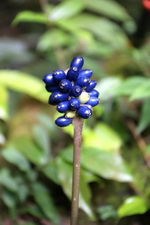
Amorphophallus crispifolius
infrutescence
|

Amorphophallus ongsakulii |

Hawkmoth Caterpillar on Amorphophallus laoticus |
Sunday, September 9, 2018
After a hearty breakfast we departed Thakhek and drove north toward Ban Lao on highway 13. We decided to make a return to the stop we made on our way down on the same highway, where we found
Amorphophallus croatii to get a few more photos. We decided to climb higher up the mountain than we had earlier and found a
Globba species in bloom with white bracts and nicely constrasting orange flowers, as well as a new
Amorphophallus species which seems to be related to
A. schmidtiae.
Since we reached Ban Lao by lunch, we opted to drive back east on highway 8. We made a few stops along this road finding Amorphophallus brevipetiolatus, A. schmidtiae, as well as an undescribed species that Petra, Annop and Alan had previously found back in 2003.
We returned back to Ban Lao just before dark and located a hotel for the night.
Alan’s pics for today:
September 9, 2018
Copyright 2018 to present
Alan Galloway |

Stick insect
|

Amorphophallus laoticus seedhead |

Amorphophallus brevipetiolatus
|

Amorphophallus schmidtiae
|

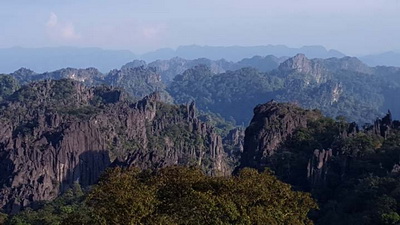


Karst Mountains – central Laos |
Bjørn’s pics for today:
September 9, 2018
Copyright 2018 to present
Bjørn Malkmus-Hussein |

Amorphophallus brevipetiolatus 1
|

Amorphophallus brevipetiolatus 2 |

Globba spec. white bracts
orange flowers
|

Amorphophallus schmidtiae
(pale brown form) |

Amorpophallus schmidtiae |
Monday, September 10, 2018
As Alan was sitting on the steps of the hotel waiting for the other guys to bring out there luggage, a tiny bird flew into a hotel window and fell to the ground unconscious. Alan picked it up before the local cat could get to it and noticed it was still alive. After about 15 minutes it came back to life and flew off. The little bird was a Little Spiderhunter (
Arachnothera longirostra). We left Ban Lao and drove back to Vientiane, a rather long drive on a road in much need of pothole repairs. Once we arrived in Vientiane, we stayed in a hotel right on the Mekong River. Our driver carried us to a fantastic restaurant for dinner, as it was our last meal together with him.
Alan’s pics for today:
September 10, 2018
Copyright 2018 to present
Alan Galloway |

Little Spiderhunter
(Arachnothera longirostra)
|
Bjørn’s pics for today:
September 10, 2018
Copyright 2018 to present
Bjørn Malkmus-Hussein |

Arachnothera longirostra
|
Tuesday, September 11, 2018
We flew from Vientiane back to Bangkok. Once we arrived in Bangkok, we made our way to the hotel. After lunch David, Derek and Alan visited Barry Yinger’s nursery (
https://www.newlifetropicals.com/) where Barry spent the afternoon touring us around his plant collection. As expected he still has a huge interest in variegated plants and probably has one of the largest collections of
Sansevieria.
Derek’s pics for today:
September 11, 2018
Copyright 2018 to present
Derek Carwood |

David at Barry Yinger's Nursery
|

Barry Yinger's Nursery |
Wednesday, September 12, 2018
After
eating breakfast in the hotel lobby we went to Chatuchak market where we spent several hours walking around looking at plants. This market probably has the greatest variety of plants for sale anywhere in the world. The afternoon was spent inventorying and cleaning plant material that was purchased at nurseries along the way in preparations for phytosanitary inspection the next day.
Alan’s pics for today:
September 12, 2018
Copyright 2018 to present
Alan Galloway
|

Caladium hybrids at Chatuchak market |

Canna at Chatuchak market |

Winner of ‘Best T-shirt
at Chatuchak
|
Friday, September 14, 2018
After leaving Bangkok, Alan had a stopover in Seoul, South Korea and then Atlanta. Since he had several hours in the Atlanta airport he was watching the news of Hurricane Florence that was scheduled to come over Raleigh the same time he was due to land in Raleigh. He was expecting his flight into Raleigh to be canceled, but it took off on time. His landing in Raleigh was one of the roughest airplane landings he ever experienced due to the hurricane winds.
Bjørn arrived at Frankfurt airport, Germany in the early morning. He stayed over a couple of days at his parents’ house in his original hometown of Wiesbaden before heading on to Tenerife, Canary Islands, Spain. As he had developed some serious illness with persistent headaches, high fever and imbalance during his stay in Wiesbaden, he went from Tenerife airport straight to the emergency at the local university hospital. Despite having done all available tests on tropical diseases in the forthcoming days, it could not be figured out what it was. Fortunately dengue, malaria, Japanese encephalitis, and all forms of typhoid fever could be discarded though. Symptoms lasted almost three weeks and then they gradually disappeared.
David and Derek had very comfortable flights home, fortunately without any troubles.


 <
<