Anthurium 'Oaxaca'
 For years, ss I had no idea what variety this is. I didn't even know if
it was a species, hybrid or cultivar. I had purchased it in a small
roadside mercado in a mountain village near Oaxaca city in December 1979.
Most of their specimens were far too large to pack. This one is the
result of an offset they were willing to uproot and prepare for me. It
has grown quite well and is now about 4 feet high.
For years, ss I had no idea what variety this is. I didn't even know if
it was a species, hybrid or cultivar. I had purchased it in a small
roadside mercado in a mountain village near Oaxaca city in December 1979.
Most of their specimens were far too large to pack. This one is the
result of an offset they were willing to uproot and prepare for me. It
has grown quite well and is now about 4 feet high.
It flowers consistently and has been virtually indestructible
compared to so many other Anthurium. Despite drought (I forget to
water), bugs (spider mite world wars as well as mealy bug), too little light
(my unlit drafty basement for 6 weeks during construction) cold (why can't I
take it out during Long Island's April) the plant appears to recover any insult
I can hurl at it. I did manage to kill one once. I left it out when
New York overnight temperature dropped to the low 20s. I can't guarantee
this but highly suspect that freezing solid is not good for an Anthurium.
In 2002 I submitted the plant to a tissue culture firm in
Florida. Upon submission, they requested a name. I named it
'Oaxaca' to remind me of that memorable 1979 trip. It was slow going at first
but they did manage to establish a culture and have distributed the plant under
the name Anthurium 'Oaxaca'. One specimen in their greenhouse is
approximately 6 feet high with inflorescences 6-8 inches in height.
In early 2008, it was available for sale on Ebay. I have
seen it advertised on Amazon using my photo. A nursery on Maui tried to
sell me one, again using my photo.
Florida friends have
successfully grown it as a landscape plant. During the 2008-09
winter, Sarasota temperatures dropped to 29°F one overnight. The Anthurium
andreanum in that yard were showing frost damage. The two 'Oaxaca' in
my friend's yard survived unscathed.
In 2009, I finally learned the possible heritage of this
plant. The email from a Central American Anthurium expert said
"This looks exactly like the many local backyard hybrids between native
white-flowered spp. from Sect. Calomystrium such as A. huxtlense
and A. armeniense and the old F1 hybrids between andraeanum and nymphaeipholium,
etc. that dominate the cut flower trade as 'andraeanum’. They are
readily available in local nurseries across southern México and Central
America."
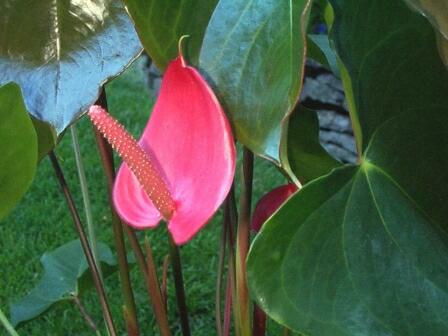
These photos are a bit grainy having been taken with a nearly
first generation digital camera back in 1999.
 s
s
click the images for close-ups of
the blooms
 s
s